
ENGOT-EN20 / XPORT-EC-042
Recruitment for the XPORT study was completed in January 2026.
Clinical trial with Selinexor as maintenance therapy following systemic therapy in patients with p53 wild-type, advanced or recurrent endometrial cancer
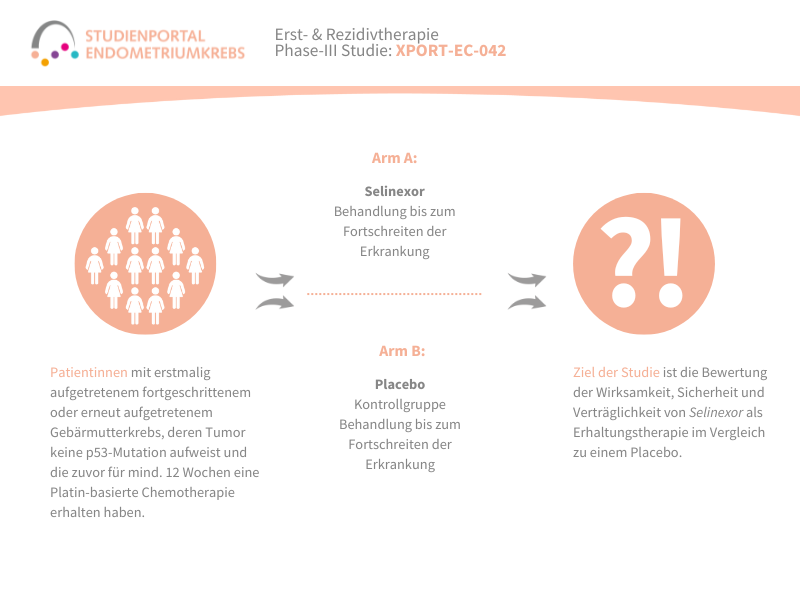
What is being investigated in this study?
The XPORT-EC-042 is a randomized (random assignment to treatment arms), placebo-controlled, double-blind (physicians and participants do not know who was assigned to which arm) Phase 3 study with Selinexor as maintenance therapy following systemic therapy in patients with advanced or recurrent endometrial cancer, without p53 mutation in tumor tissue.
The current standard therapy for the first-line treatment of advanced or recurrent endometrial cancer is the intravenous administration of carboplatin and paclitaxel (chemotherapy). Although more than half of patients respond to treatment, unfortunately, almost all patients experience a recurrence (return of the disease) within a short period. Therefore, a maintenance therapy is currently being sought that further supports the initial tumor response to chemotherapy and delays the recurrence and/or progression of the disease by eliminating residual cancer cells. Previous studies (SIGN and SIENDO) have already found initial evidence that Selinexor improves disease control in patients with endometrial cancer. The XPORT study aims to build on this and further investigate the efficacy of Selinexor as maintenance therapy in patients with endometrial carcinoma without p53 mutation.
The SIGN study was a Phase 2 study evaluating the safety and efficacy of Selinexor in patients with advanced gynecological malignancies. The results demonstrate the efficacy of the drug in patients with heavily pretreated gynecological cancers. The SIENDO study is a study with Selinexor as maintenance therapy compared to placebo after combination chemotherapy in patients with advanced or recurrent endometrial cancer. An analysis of the SIENDO data showed that patients with endometrial cancer without p53 mutation have a significant improvement with Selinexor maintenance therapy compared to placebo. Selinexor was also safe and reasonably well tolerated in the SIENDO study.
Selinexor is a selective inhibitor, meaning it specifically inhibits a certain protein (Exportin-1). This protein is responsible for transporting certain proteins, growth regulators, and tumor-specific mRNAs out of the cell nucleus. If Exportin-1 is inhibited, these proteins accumulate in the cell nucleus and can cause cell death, thereby inhibiting tumor growth.
What is the aim of the study?
The main objective of the study is to evaluate the efficacy of Selinexor as maintenance therapy compared to placebo. For this purpose, overall survival and progression-free survival (i.e., from the start of treatment within the study until further progression of the disease) are compared between the two treatment arms. In addition, the safety and tolerability of Selinexor, as well as the quality of life during treatment, are evaluated.
What is the study procedure?
Patients are randomly assigned to one of the two treatment arms in a 1:1 ratio:
Arm A: Selinexor
Arm B: Placebo
In both treatment arms, drug treatment continues until disease progression.
Are there any risks?
You will be informed about possible risks or side effects associated with participation during an informational discussion.
Eligibility requirements:
Women aged 18 and over can participate in this study if they meet the following criteria:
- with newly confirmed diagnosis of advanced (Stage IV) or recurrent endometrial cancer
- tumor shows no p53 mutation
- at least 12 weeks of platinum-based chemotherapy as prior treatment
In addition, there are other criteria that must be met for participation in the study. Further information can be obtained from your treating physicians.
This study is supported by: