Author Archives: Jessica Nguyen

New Findings from ASCO 2026

As part of the NOGGO Gynecological Oncology Update, the most important studies from this year’s ASCO Congress were presented.

RUBY Study: Long-term Benefit of Immunotherapy Confirmed

New long-term data from the RUBY study confirm the sustained benefit of the immunotherapy dostarlimab in combination with chemotherapy for patients with dMMR endometrial cancer (tumors with a DNA repair deficiency).

Long-term observation shows that many patients benefit permanently from the treatment and live long-term without disease progression. According to the study authors, there is even the prospect of permanent disease control or even a potential cure for a portion of these patients.

The results thus underscore the high significance of the combination of dostarlimab and chemotherapy for patients with dMMR endometrial cancer.

Abstracts of the presented studies can be found directly on the ASCO website (the site is in English).

In the coming days, you will also find short videos on the highlights of ASCO on our social media channels!

DESTINY-ENDOMETRIAL01

DESTINY-ENDOMETRIAL01

THERAPY STUDY COMBINING TRASTUZUMAB DERUXTECAN (T-DXD) AND RILVEGOSTOMIG OR PEMBROLIZUMAB IN PATIENTS WITH ADVANCED OR RECURRENT ENDOMETRIAL CANCER

The DESTINY-Endometrial01 is a global, randomized (treatment assignment for the individual patient is by chance) Phase 3 study investigating a new treatment option for patients with advanced or recurrent endometrial cancer whose tumor cells overexpress HER2 and have a pMMR status. Two new combination therapies with the drug Trastuzumab deruxtecan (T-DXd with Rilvegostomig or Pembrolizumab) are compared with the current standard therapy of chemotherapy and immunotherapy. The aim is to find out whether the new treatments can prevent disease progression for longer.

What is being investigated in this study?

Endometrial carcinomas are among the most common cancers of the uterus.

For patients with advanced or recurrent disease at initial diagnosis, standard treatment often consists of a combination of chemotherapy and immunotherapy. Nevertheless, many patients experience disease progression over time, which is why new therapeutic approaches are needed.

The study targets patients whose tumors express human epidermal growth factor receptor 2 (HER2). HER2 is a protein on the surface of tumor cells that can transmit growth signals to the cancer cell. Some endometrial carcinomas show an increased presence of HER2, which can be used as a target for directed therapies.

In addition, the tumors must have a so-called pMMR status (proficient Mismatch Repair). This means that this repair system for genetic errors is fundamentally functional. These tumors often respond less well to immunotherapies than tumors with a defective repair system (dMMR), which is why new treatment strategies are being investigated.

This study uses, among other things, Trastuzumab deruxtecan (T-DXd). This is a so-called antibody-drug conjugate (ADC). The antibody specifically recognizes HER2 on the surface of tumor cells and then introduces a cell toxin into the cancer cell to destroy it.

In this study, T-DXd is combined either with Pembrolizumab, an immunotherapy, or with Rilvegostomig. Rilvegostomig is a new immunotherapeutic agent designed to simultaneously influence various mechanisms of the immune system to strengthen the body’s defense against the tumor.

What is the aim of the study?

The primary objective of the study is to investigate whether the combination of Trastuzumab deruxtecan with Rilvegostomig or Pembrolizumab can prevent disease progression for longer than the current standard treatment of chemotherapy and Pembrolizumab.

Furthermore, the study will investigate whether the new treatment strategies affect overall survival and how well the therapies are tolerated. Quality of life and patient-reported symptoms during treatment will also be examined.

What is the study procedure?

Patients participating in the study will be randomly assigned to one of three treatment arms:

Arm 1:
Trastuzumab deruxtecan + Rilvegostomig as an infusion every three weeks.

Arm 2:
Trastuzumab deruxtecan + Pembrolizumab as an infusion every three weeks.

Arm 3:
Current standard therapy consisting of chemotherapy with Carboplatin and Paclitaxel + Pembrolizumab for 6 treatment cycles. Subsequently, Pembrolizumab will be continued as maintenance therapy for up to 14 cycles.

Treatment will be continued in all study arms until disease progression, unacceptable side effects occur, or other reasons for discontinuing therapy arise.

Throughout the study, regular examinations will take place to monitor the effect of the treatment, possible side effects, and the general health status of the patients.

Are there risks?

You will be informed about possible risks or side effects associated with participation by your doctor during an informational consultation.

Eligibility criteria:

Women aged 18 years and older can participate in this study with:

  • confirmed diagnosis of epithelial endometrial carcinoma. All histological types are permissible, with the exception of sarcomas (carcinosarcomas are permissible).
  • advanced endometrial carcinoma (Stage III/IV) at initial diagnosis or first recurrence of endometrial carcinoma
  • centrally confirmed positive HER2 status (IHC 3+ or 2+)
  • confirmed pMMR status (functional MMR repair mechanism)
  • No prior systemic therapy for the disease is allowed, with the exception of: adjuvant/neoadjuvant chemotherapy or chemoradiotherapy (for recurrences, recurrence or progression of the disease must have occurred ≥ 6 months after the last chemotherapy dose), treatment with Trastuzumab in the adjuvant/neoadjuvant setting and previous radiation therapy are permitted
  • Previous treatment with ADCs or immune checkpoint inhibitors, including (but not limited to) anti-PD-1/PD-L1/PD-L2 and anti-CTLA-4 antibodies, as well as therapeutic cancer vaccines, is not permitted.

In addition, there are other criteria that must be met for participation in the study. Further information can be obtained from your treating physicians.

Further information on the study and centers where participation is possible can be found on the study homepage: https://www.astrazenecaclinicaltrials.com/study/D781DC00001/

This study is conducted by:

PYNNACLE STUDY

PYNNACLE STUDY

THERAPY STUDY TO EVALUATE THE EFFICACY AND SAFETY OF THE NEW ACTIVE SUBSTANCE REZATAPOPT IN PATIENTS WITH LOCALLY ADVANCED OR METASTATIC SOLID TUMORS

The PYNNACLE study is a phase 1/2 clinical trial investigating a new medication called Rezatapopt. The study is aimed at patients with various advanced or metastatic cancers (e.g., ovarian, breast, lung, or endometrial cancer) whose tumor has a specific genetic alteration called the TP53-Y220C mutation. The objective is to determine how safe and effective Rezatapopt is and which dose is most suitable.

Participation:

Further information about the study and centers where participation is possible can be found on the study homepage: https://www.pynnaclestudy.com/

ENGOT-EN20 / XPORT-EC-042 (Recruitment completed)

ENGOT-EN20 / XPORT-EC-042
Recruitment for the XPORT study was completed in January 2026.

Clinical trial with Selinexor as maintenance therapy following systemic therapy in patients with p53 wild-type, advanced or recurrent endometrial cancer

What is being investigated in this study?

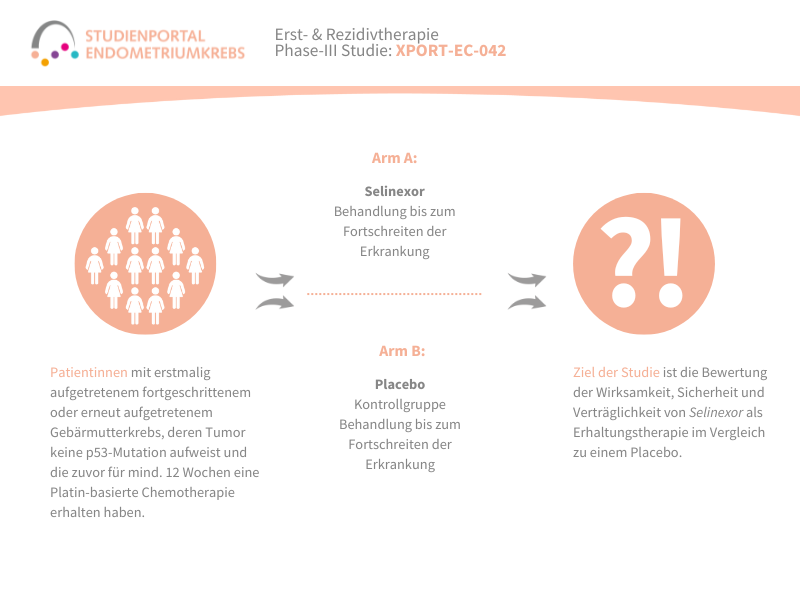
The XPORT-EC-042 is a randomized (random assignment to treatment arms), placebo-controlled, double-blind (physicians and participants do not know who was assigned to which arm) Phase 3 study with Selinexor as maintenance therapy following systemic therapy in patients with advanced or recurrent endometrial cancer, without p53 mutation in tumor tissue.

The current standard therapy for the first-line treatment of advanced or recurrent endometrial cancer is the intravenous administration of carboplatin and paclitaxel (chemotherapy). Although more than half of patients respond to treatment, unfortunately, almost all patients experience a recurrence (return of the disease) within a short period. Therefore, a maintenance therapy is currently being sought that further supports the initial tumor response to chemotherapy and delays the recurrence and/or progression of the disease by eliminating residual cancer cells. Previous studies (SIGN and SIENDO) have already found initial evidence that Selinexor improves disease control in patients with endometrial cancer. The XPORT study aims to build on this and further investigate the efficacy of Selinexor as maintenance therapy in patients with endometrial carcinoma without p53 mutation.

The SIGN study was a Phase 2 study evaluating the safety and efficacy of Selinexor in patients with advanced gynecological malignancies. The results demonstrate the efficacy of the drug in patients with heavily pretreated gynecological cancers. The SIENDO study is a study with Selinexor as maintenance therapy compared to placebo after combination chemotherapy in patients with advanced or recurrent endometrial cancer. An analysis of the SIENDO data showed that patients with endometrial cancer without p53 mutation have a significant improvement with Selinexor maintenance therapy compared to placebo. Selinexor was also safe and reasonably well tolerated in the SIENDO study.

Selinexor is a selective inhibitor, meaning it specifically inhibits a certain protein (Exportin-1). This protein is responsible for transporting certain proteins, growth regulators, and tumor-specific mRNAs out of the cell nucleus. If Exportin-1 is inhibited, these proteins accumulate in the cell nucleus and can cause cell death, thereby inhibiting tumor growth.

What is the aim of the study?

The main objective of the study is to evaluate the efficacy of Selinexor as maintenance therapy compared to placebo. For this purpose, overall survival and progression-free survival (i.e., from the start of treatment within the study until further progression of the disease) are compared between the two treatment arms. In addition, the safety and tolerability of Selinexor, as well as the quality of life during treatment, are evaluated.

What is the study procedure?

Patients are randomly assigned to one of the two treatment arms in a 1:1 ratio:

Arm A: Selinexor

Arm B: Placebo

In both treatment arms, drug treatment continues until disease progression.

Are there any risks?

You will be informed about possible risks or side effects associated with participation during an informational discussion.

Eligibility requirements:

Women aged 18 and over can participate in this study if they meet the following criteria:

  • with newly confirmed diagnosis of advanced (Stage IV) or recurrent endometrial cancer
  • tumor shows no p53 mutation
  • at least 12 weeks of platinum-based chemotherapy as prior treatment

In addition, there are other criteria that must be met for participation in the study. Further information can be obtained from your treating physicians.

This study is supported by:

AGO-OP.6 – ECLAT

AGO-OP.6 – ECLAT

Study for patients with stage I or II endometrial cancer at high risk of recurrence – a multicenter, prospective, randomized controlled trial

What is being investigated in this study?

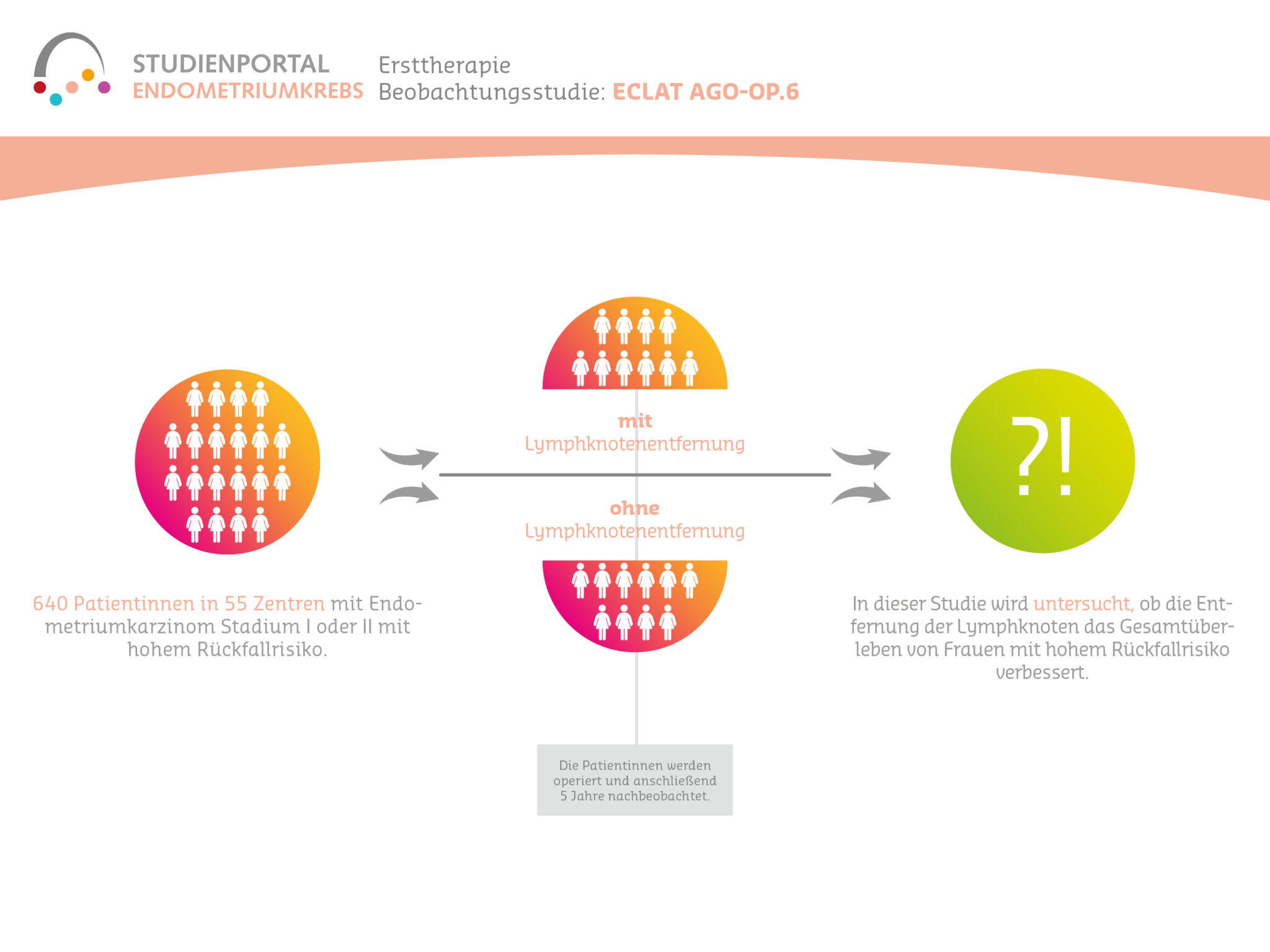
This study investigates whether removal of the lymph nodes in the pelvis and alongside the abdominal aorta improves overall survival in women with uterine cancer at high risk of recurrence.

What is the aim of the study?

The study aims to clarify whether the previously standard removal of the lymph nodes in the pelvis and along the abdominal aorta in women with uterine cancer at high risk of recurrence improves the chances of cure (overall survival). If this is the case, this operation should continue to be recommended; if not, it should be omitted in the future.

What is the study procedure?

The study is being conducted nationwide in Germany at around 55 centers, and a total of 640 patients are to be included. This is a clinical study in which patients undergo surgery and are then followed up for 5 years.

It is a prospective, randomized, two-arm, multicenter, open-label study.

Eligible patients are randomly assigned to either receive the previously standard lymph node removal or to forgo it. For all patients, given the high risk of recurrence, vaginal radiotherapy (brachytherapy) and chemotherapy (carboplatin/paclitaxel) are recommended as adjuvant treatment after surgery.

Are there any risks?

You will be informed about possible risks and/or side effects associated with participation as part of an informed-consent discussion.

Eligibility requirements:

Women aged 18–75 years can participate in this study if the following criteria are met:

Excerpt from the inclusion criteria:

  • Histologically confirmed endometrial cancer, clinical stage I or II, high risk of recurrence
    No previous surgery for endometrial cancer
  • or surgery after hysterectomy (surgical removal of the uterus) within 8 weeks if no LNE has yet been performed
  • No enlarged lymph nodes
    ECOG performance status 0–1

Excerpt from the exclusion criteria:

  • Recurrence of endometrial cancer
  • Sarcomas
  • FIGO stage III or IV
  • Previous chemo-, radio-, or endocrine therapy for endometrial cancer

In addition, there are further criteria that must be met to participate in the study. Interested patients should speak with a study physician at a study center, who can assess whether you are eligible for this study.

This study investigates whether removal of the lymph nodes in the pelvis and alongside the abdominal aorta improves overall survival in women with uterine cancer at high risk of recurrence.