
DUOLife
Observational study on first-line therapy in patients with advanced or recurrent endometrial cancer
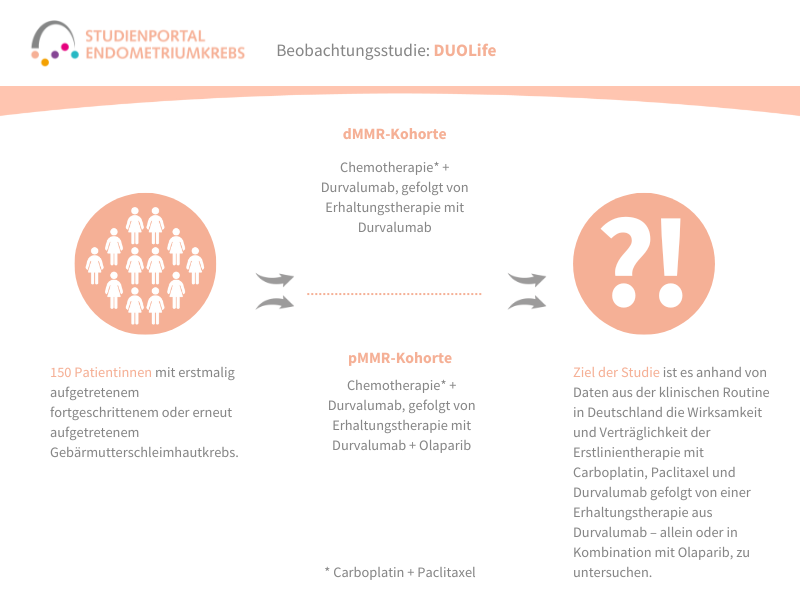
The DUOLife study is a non-interventional observational study. This means that patients receive an already planned or initiated and approved therapy – no therapies or other interventions are prescribed or adjusted by the study. This study aims solely to collect data on real-world experience from routine treatment in Germany (real-world data): How effective and tolerable is first-line therapy with carboplatin, paclitaxel, and durvalumab, followed by maintenance therapy with durvalumab – alone or in combination with olaparib – in patients with advanced or recurrent endometrial cancer (also known as uterine cancer)?
What is being investigated in this study?
Advanced (FIGO III or IV) or recurrent endometrial cancer is increasingly treated with chemotherapy in combination with immunotherapy. This study investigates how well such a therapy works in routine clinical practice. Large clinical trials have already confirmed the benefit of these therapies in hundreds of patients. Now, the effect is to be investigated outside of large clinical trials in normal routine treatment in Germany. This makes it possible to examine the effect of the therapy even in patients who did not participate in or could not participate in the clinical trials.
Durvalumab is an immune checkpoint inhibitor. The drug helps the body’s immune system better recognize and fight cancer cells. Many tumor cells are protected from attack by immune cells by a specific protein (PD-L1) on their surface. Durvalumab blocks this protective mechanism, allowing the immune system to attack the cancer cells. The combination of chemotherapy and immunotherapy can mutually reinforce each other: chemotherapy can damage tumor cells, making them more “visible” to the immune system – and durvalumab then helps the immune system fight them more effectively.
After chemotherapy, durvalumab is continued as maintenance therapy to keep any remaining cancer cells under long-term control and prevent recurrence.
Endometrial cancer can have different biological characteristics. An important factor is whether certain repair mechanisms in the tumor cells are functional or not. One of these repair mechanisms is called mismatch repair (MMR).
If this repair mechanism does not work, it is referred to as dMMR (deficient mismatch repair). Such tumors often have many genetic changes and frequently respond particularly well to immunotherapies like durvalumab.
If the repair system functions normally, it is referred to as pMMR (proficient mismatch repair). These tumors are generally less sensitive to immunotherapies, so additional drugs such as olaparib are used to enhance the effect.
Olaparib is a PARP inhibitor, a drug that prevents cancer cells from repairing damage to their DNA. The addition of olaparib to durvalumab maintenance therapy in pMMR tumors can help better control tumor growth by making cancer cells more susceptible to an immune response. This therapeutic benefit has already been demonstrated in the past, for example, by the DUO-E study.
The goal is to achieve the most effective and long-term control of the disease, even in patients with pMMR tumors, through the combined maintenance therapy of durvalumab + olaparib.
What is the aim of the study?
The DUOLife study focuses on the question of how long it takes until the next therapy is needed – a measure called rwTTNT (real-world Time to Next Treatment). In addition, it also assesses, among other things, how long the disease remains under control (rwPFS = real-world progression-free survival), what side effects occurred, and how patients are doing in their daily lives (quality of life, symptoms).
What is the study procedure?
A total of approximately 150 patients are expected to participate in Germany. All will receive a therapy that is already used in clinical routine – so it is not a clinical study with experimental treatment.
For every patient with endometrial cancer, the tumor’s dMMR or pMMR status is determined at diagnosis. Depending on their diagnosis, patients can be enrolled in one of these two groups:
- dMMR cohort: Patients receive chemotherapy in combination with durvalumab. This is followed by maintenance therapy with durvalumab.
- pMMR cohort: Patients also receive the combination of chemotherapy and durvalumab, followed by maintenance therapy with durvalumab plus olaparib.
For the study, no additional examinations or visits to the study center beyond routine care are required. In addition to routine examinations, you will only be asked to complete questionnaires for the evaluation of quality of life.
Are there risks?
This is a purely observational study, meaning patients receive their planned or already initiated cancer therapy. They do not receive any additional medications or other treatments (excluding medications for comorbidities or medications for potential side effects of routine treatment). The risks and side effects are therefore the same as if the treatment were to take place outside of this observational study.
Eligibility criteria:
Women aged 18 years and older can participate in this study if they have:
- Advanced (FIGO stage III or IV) or recurrent endometrial cancer
- Known MMR status (genetic characteristic of the tumor, determined at diagnosis: dMMR or pMMR)
- Planned or already initiated first-line therapy with a combination of chemotherapy (carboplatin + paclitaxel, abbreviated CP) and durvalumab
- Willingness to regularly complete quality of life questionnaires (known as PROs – patient-reported outcomes)
However, there are also other criteria that must be met for participation in the study. Further information can be obtained from your treating physicians.
This study is supported by: