
ENGOT-EN29 / TroFuse-033
Therapy study on the combination of Sacituzumab Tirumotecan (SAC-TMT) and Pembrolizumab as maintenance therapy in patients with advanced or recurrent endometrial cancer
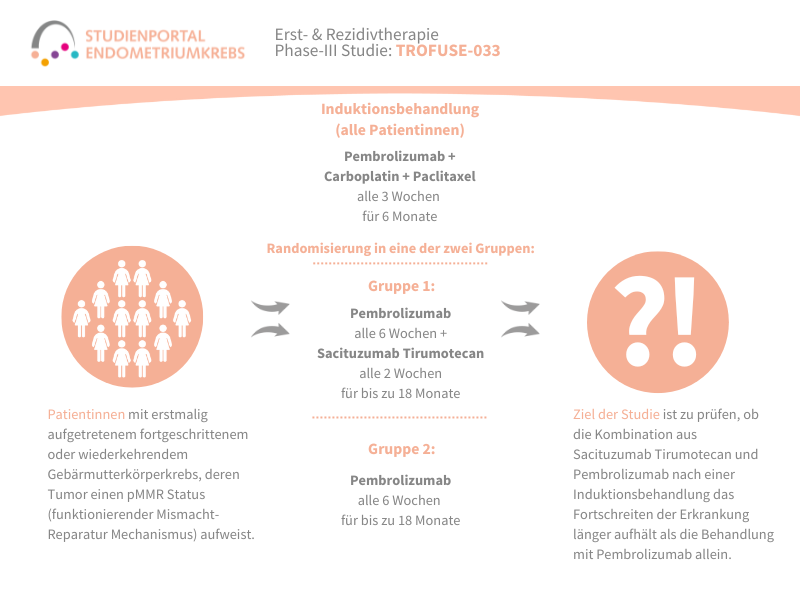
The TroFuse-033 study is an international, randomized (the treatment assignment for the individual patient is determined by chance) phase 3 study investigating a new combination therapy in patients with advanced or recurrent endometrial cancer whose tumor exhibits a functioning so-called mismatch repair mechanism (pMMR). The study examines whether a combination of Sacituzumab Tirumotecan (sac-TMT) and Pembrolizumab as maintenance therapy is more effective than maintenance therapy with Pembrolizumab alone.
What is being investigated in this study?
Endometrial cancer is one of the most common cancers of the uterus. When the disease is advanced or returns after surgery, treatment options are often limited.
Endometrial cancer can exhibit different biological characteristics. An important factor is whether certain repair mechanisms in the tumor cells are functional or not. One of these repair mechanisms is called mismatch repair (MMR).
When this repair mechanism does not function, it is referred to as dMMR (deficient mismatch repair). Such tumors often have many genetic alterations and frequently respond particularly well to immunotherapies such as Pembrolizumab.
If the repair system functions normally, it is referred to as pMMR (proficient mismatch repair). Patients with pMMR tumors often respond only to a limited extent to immunotherapies.
This study therefore examines a new therapeutic approach: Sacituzumab Tirumotecan (sac-TMT), an antibody-drug conjugate that can target cancer cells specifically, is combined with Pembrolizumab, an immunotherapy. The goal is to enhance the effect of Pembrolizumab and delay disease progression for a longer period.
What is the goal of the study?
The primary goal of the TroFuse-033 study is to examine whether patients with the combination of sac-TMT and Pembrolizumab live longer without disease progression than patients who receive only Pembrolizumab. Additionally, the study aims to investigate whether overall survival is extended and how well the therapy is tolerated.
What is the course of the study?
At the beginning, all participants receive a so-called induction treatment. This consists of the immunotherapy Pembrolizumab combined with the chemotherapy agents Carboplatin and Paclitaxel. The induction treatment is administered every 3 weeks for a total of 6 months.
If the disease does not progress further during this phase, patients transition to the maintenance phase. There they are randomly assigned to one of two groups:
Group 1:
Pembrolizumab every 6 weeks + Sacituzumab Tirumotecan every 2 weeks for up to 18 months
Group 2:
Pembrolizumab every 6 weeks for up to 18 months
If the disease progresses again despite these treatments, the treatment is discontinued and patients are treated outside the study.
Are there risks?
You will be informed about possible risks or side effects associated with participation during an informed consent discussion with your physician.
Participation requirements:
Women aged 18 years and older can participate in this study with:
- confirmed diagnosis of newly diagnosed, advanced (stage III or IV) or recurrent endometrial cancer
- confirmed pMMR status (functioning MM repair mechanism)
- no prior systemic therapy for the disease in the advanced stage, except: chemotherapy in early cancer stage, radiation ± chemotherapy (completed at least 2 weeks before the start of study treatment), hormone therapy (completed at least 1 week before the start of study treatment)
In addition, there are other criteria that must be met for participation in the study. Further information is available from your treating physicians.
This study is supported by: