
NOGGO S18 – EMRISK
Recruitment of patients with endometrial cancer has been completed for this study.
Development of a Risk Prediction Model for Nausea and Vomiting During Chemotherapy
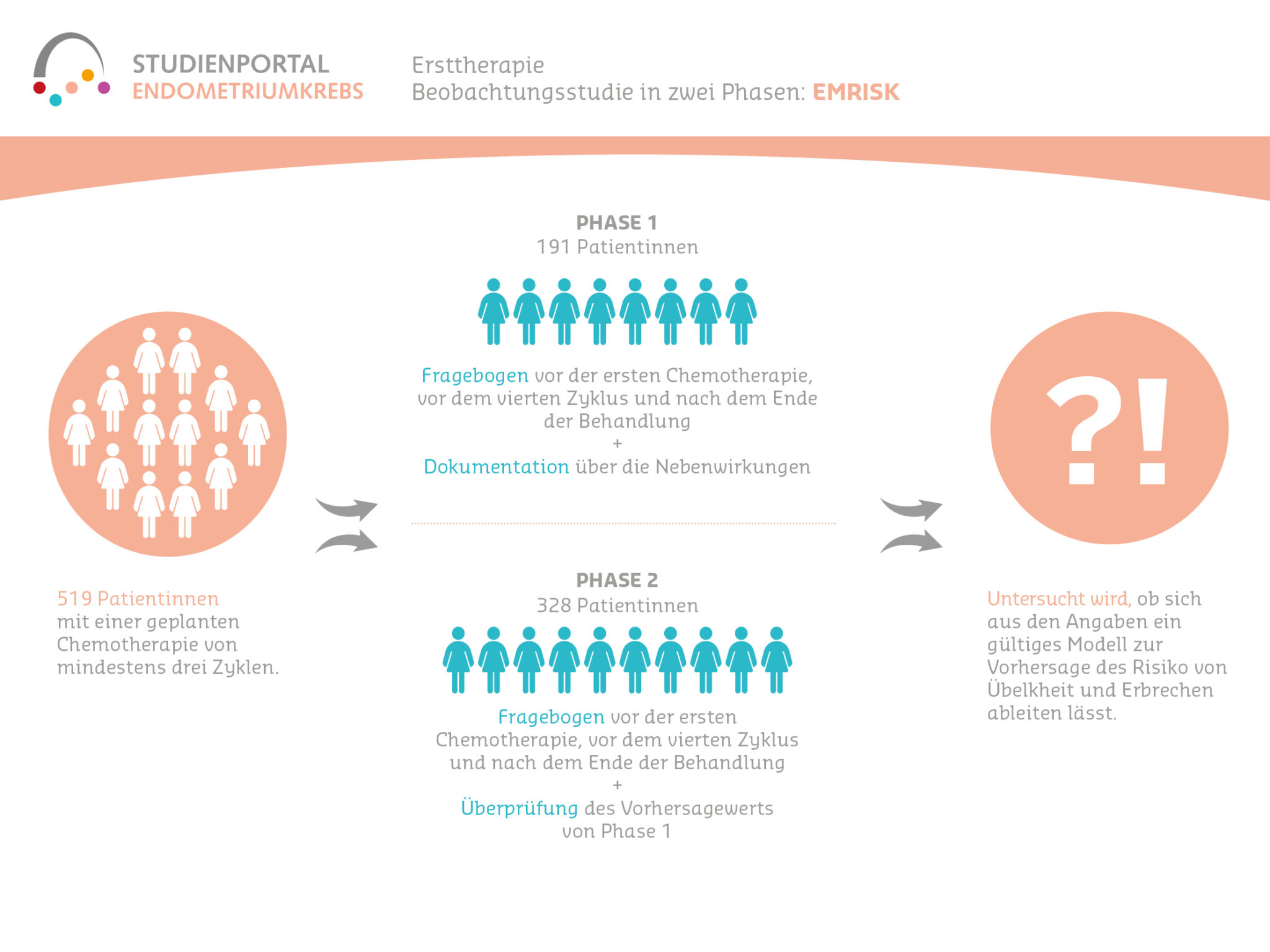
What is being investigated in this study?
The EMRISK study is an observational study in two phases in which patients are surveyed about their medical history and risk factors for nausea and vomiting and about the actual occurrence of nausea and vomiting during chemotherapy. The study investigates whether a valid model for predicting the risk of nausea and vomiting can be derived from this information.
What is the objective of the study?
This study aims to develop a model to predict a patient’s risk of nausea and vomiting during chemotherapy.
What is the study procedure?
The study will be conducted with a total of 519 patients. In the first phase, 191 patients complete a questionnaire before their first chemotherapy session that provides information about their personal risk factors for nausea and vomiting. During chemotherapy treatment, a diary is then used to document when and how severely nausea and vomiting actually occur.
Correlations between the risk factors and the occurrence of nausea and vomiting are identified in order to develop a model that calculates the personal risk for each individual patient. Before the first chemotherapy session, before the fourth cycle, and after the end of treatment, patients are surveyed about their quality of life using the QLQ-C30 questionnaire. In the second phase, this model is applied to 328 patients before their treatment to verify its predictive value.
The first study phase has already been successfully completed.
Are there any risks?
No, EMRISK is an observational study. Patients participating in the study would receive the same therapy if they were not participating in the study. Therefore, study participation does not entail any risks.
Participation Requirements:
Women aged 18 years and older can participate in this study
- who have been diagnosed with a primary gynecological cancer,
- with planned chemotherapy of at least three cycles, adjuvant and neoadjuvant (as standard therapy),
- who are willing and able to complete the questionnaires and maintain the diary,
- and who have provided written informed consent.
This study is supported by:

Updated on: January 22, 2025